Working Together: A Community Working Group and Board#
Status: we’ve made our suggestion and moved on. It’s now up to the groups to take this forward if they want to.
Last updated 15 November 2026
The proposal in brief
- What: a partnership of Farnham’s residents’ associations, working together and helping each other rather than working in isolation.
- How the work is shared: a simple public board, where each association shows what it’s working on, so anyone can see what’s happening and who to contact.
- Why: many residents find it hard to see what’s happening locally and who’s taking it forward. Changes to how planning decisions are made, and the new West Surrey Council from April 2027, will also call for new ways of working.
- Where Neighbourhood CIL fits: it’s not the point of the proposal. The Town Council’s new fund is simply a mechanism that could act as a catalyst, giving associations an immediate reason to work together.
- What it isn’t: a new hierarchy or umbrella body. Every association keeps its independence.
- Who takes it forward: the associations, however they see fit. Farnham Voice wasn’t started to connect and manage residents’ associations. We expect an association would need to lead this, but a suitable association has not yet been identified. We’re happy to help whoever takes it on. More below.
- Where it stands: an idea for discussion, first shared in our Community Partnership invitation. The board is a mockup and nothing is decided.
- Get involved: email us with your views, or try the board mockup.
The rest of this page explains why we suggested this, how the partnership and board could work, where Neighbourhood CIL fits, and who would take it forward.
Why we started this#
One of the biggest pieces of feedback we’ve received, and the reason this effort started, is that people in Farnham don’t have a clear picture of what’s happening locally, or who’s taking it forward.
Finding out shouldn’t mean knowing ten different websites, the right people and their direct contacts, or which councillor to ask. A single public board, kept up to date by the associations themselves, could give everyone one place to look, and point them on to the right people.
Changes to planning decisions#
There’s another reason for associations to work together now. From 31 October 2026, most planning applications, including householder extensions and schemes of fewer than ten homes, will generally be decided by planning officers rather than at a public councillors’ committee. Councillors from across local politics have raised concerns that this could reduce residents’ say:
- Farnham leader warns planning shake-up could weaken local democracy (Farnham Herald, 7 October 2026): Cllr George Murray, leader of Farnham Town Council.
- Should local people lose their say on planning decisions? (Farnham Herald, 26 October 2026): an opinion piece by Cllr Jane Austin.
With fewer public committee hearings, residents’ views will more often need to be made in writing, through the planning portal. Associations that share what they know (which applications are coming up, what counts in planning terms and how to comment) could lessen the burden on any one group, and help build clear, well-informed local feedback on planning.
A new council from April 2027#
From 1 April 2027, West Surrey Council replaces Waverley Borough Council and Surrey County Council. A change on that scale will call for new ways of working, and associations that already share information and speak with a joined-up voice will be better placed to engage positively with the new council.
What we’re proposing#
1. Associations working together#
This is the point of the proposal: a partnership in which Farnham’s associations share what they know, compare experiences and help one another overcome obstacles, as an informal working group.
If one association runs into a problem, others could learn from it and adapt their approach. If several groups are pursuing similar improvements, they could share information, coordinate resources and strengthen each other’s case.
The aim isn’t more meetings or more paperwork. It’s a practical way for groups to work together rather than in isolation.
2. A public board, to share the work openly#
To support the partnership, we’re suggesting a simple board that anyone can view, with no sign-in needed. It’s a mechanism for sharing the work transparently: it would show residents, councillors and other groups what each association is working on, openly, then send them straight to that association: its website, its email, its contact details. Each association would manage its own cards, so the information stays theirs.
The board could show any work an association is doing: improvements it’s pursuing, issues it’s still looking into, and funding bids of any kind. That way there could always be one transparent place showing what’s happening across Farnham, with each association in control of its own part.
This is a mockup, to show the idea. What the board includes, how it works and what it leaves out would all be discussed and agreed with the associations taking part.
For each piece of work, the board could show:
- What it is: what’s being worked on or asked for, and which association is leading it.
- Status: how far it has got.
- Key contacts: a link to the association’s own website or contact details, and council contact points where appropriate.
- Progress and blockers: important updates, obstacles and next steps.
- Checklists: the tasks left, so it’s easy to see what still needs doing.
- Collaboration: where other associations could contribute or support similar work.
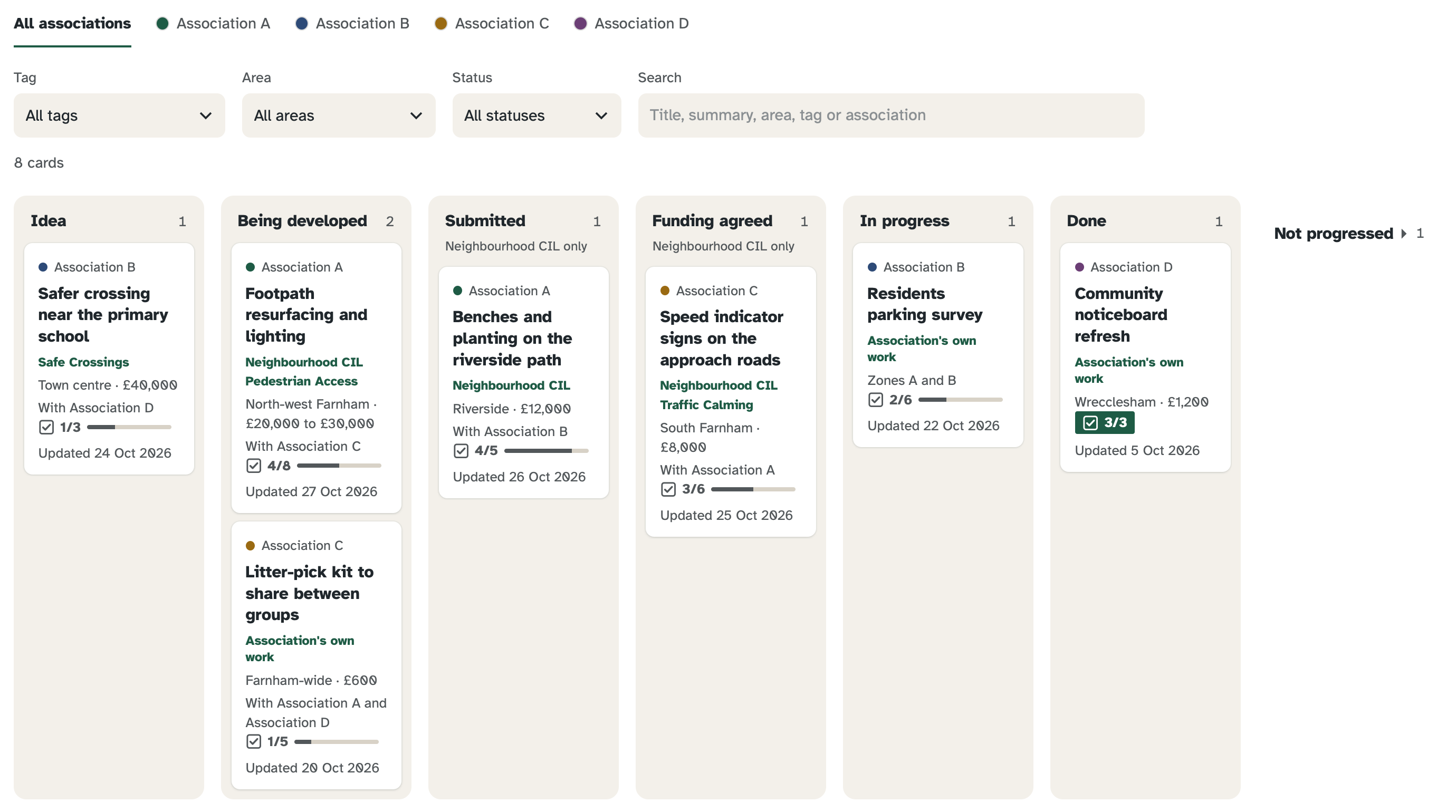
A mockup of the Community Board, to show the idea only. The associations and proposals shown are examples, not real ones.
Mockup A closer look at the mockup: stages, tags, cards and checklists
Each proposal is a card in a column showing how far it has got. The stages are kept general so they could suit any kind of work: Idea, Being developed, In progress and Done, plus Not progressed. Neighbourhood CIL proposals have two extra stages in between, Submitted and Funding agreed, which only appear for those cards. These are a starting point for discussion, not a fixed design.
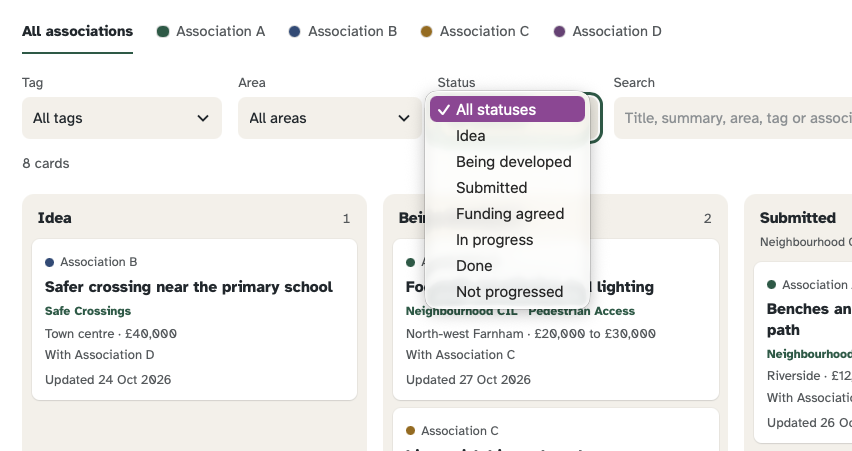
The mockup’s stages, from first idea to done. Submitted and Funding agreed only apply to Neighbourhood CIL proposals.
In the mockup, cards can be tagged, for example Neighbourhood CIL, Safe Crossings, Traffic Calming, Pedestrian Access or Association’s own work, so anyone can filter the board to one area of work. It can also be filtered by association and by area of Farnham.
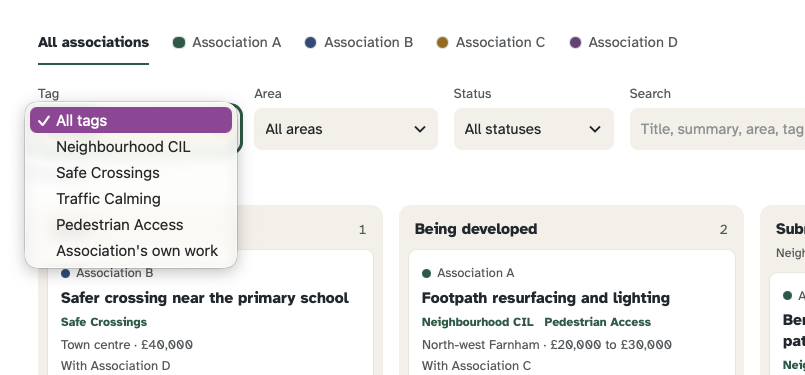
Tags would let you see one area of work at a time.
In the mockup, opening a card shows the details: a summary, the stage, the area, an estimated cost, the funding route, partner associations, a link to the evidence and who to contact.
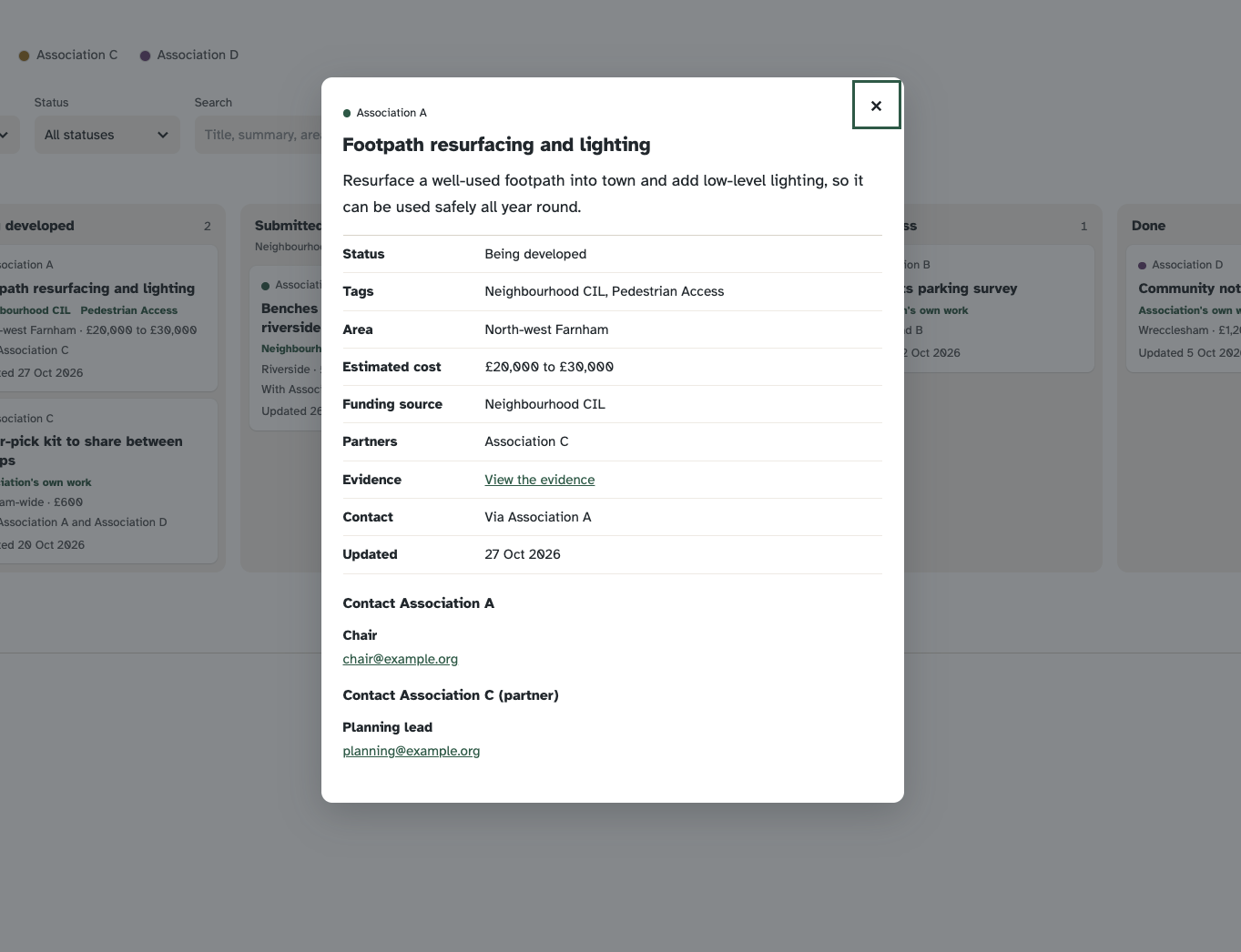
An example card. Partner associations are listed alongside the lead, to show who’s working together.
Cards could also hold checklists, much like Trello’s. A proposal often has several strands of work going on at once, such as gathering evidence, getting costs and permissions, and building support. Each strand could have its own checklist with a progress bar, and the card on the board would show how many tasks are done overall, so anyone could see at a glance what’s left.
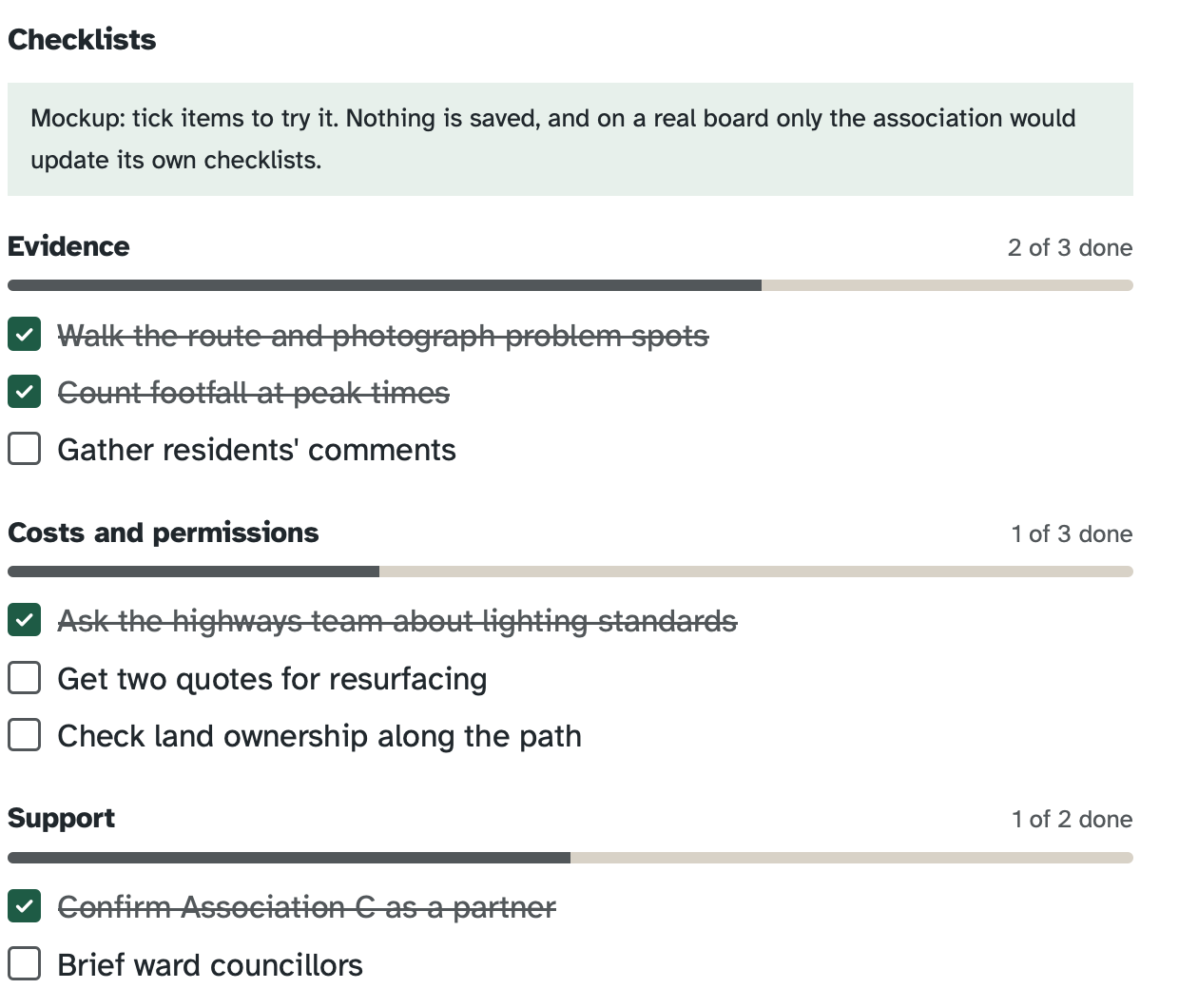
Checklists in the mockup. Each workstream shows its own progress. In the mockup you can tick items to try it out.
There are two ways it could be run. We’d recommend the first, but this would be for the associations to decide:
- A small custom-built website (recommended). A simple board built for the working group’s needs, like the mockup above. It takes some initial development time, but it can be shaped around what the community actually needs and changed as those needs change. Each association would have its own sign-in to manage its proposals independently, and could only change its own cards.
- Trello or a similar platform. An off-the-shelf board is quick to set up, and we’ve used Trello to try the idea out. But it would limit how far the board could be adapted to the community’s needs, since we’d be working within what the platform allows. Free plans also have limits, so as more associations joined, key features could end up behind a paywall.
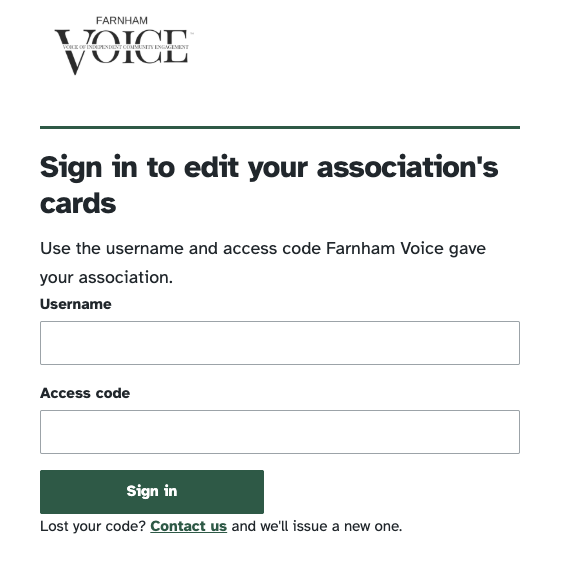
In a custom-built version, each association could sign in to update its own cards.
Either way, we’d suggest that the public board holds no personal or sensitive information, with internal discussions and working notes kept separate and access limited to the people involved.
The technology is the easy part. The real value comes from associations sharing what they’re doing, talking to each other and helping each other move their work forward. A board would just make that work easier to follow, and more open to the wider community.
3. Understanding how each association works#
Not every association works the same way, and they shouldn’t have to. Some have established committees and websites. Others are simply neighbours working together on a shared concern.
Signposting associations
We’ve already started signposting associations. We’d like to build a clearer picture of each group’s structure, resources and capacity to take proposals forward. That could help show where extra support is needed, particularly when several groups have similar proposals or funding needs.
These are the residents’ associations and community groups we’ve signposted so far:
Castle Street Residents Association
Speaks for Castle Street residents
The Chantrys Community Association
Speaks for the Chantrys estate and the surrounding area
Hale Carnival
The community-run carnival in Upper Hale, every July
North Farnham Voice
Speaks for the north Farnham villages, from Hale and Heath End to Weybourne and Badshot Lea
North West Farnham Residents' Association
Speaks for North West Farnham, from Alton Road to Odiham Road and Folly Hill to Dippenhall
Old Park Lane Residents Association
Speaks for Old Park Lane residents
Contact details coming soon
Park View Residents Association
Speaks for Park View residents
Contact details coming soon
South Farnham Residents' Association (SOFRA)
Speaks for South Farnham
Upper Old Park Lane Residents Association
Speaks for Upper Old Park Lane residents
Contact details coming soon
Weybourne Community Association
Speaks for Weybourne
Is your association missing?
We'll add it to the list
What we’re not proposing#
A new hierarchy, an umbrella authority, or a group that decides what other associations can and can’t do.
Every association keeps its independence, its autonomy and its ability to speak for its own community. This isn’t another layer of bureaucracy, or a forum built around individual personalities. The purpose is practical collaboration, not control.
Each association stays responsible for its own proposals and decisions. The working group would simply be a way to share information, spot opportunities to work together, and help one another when problems come up.
We’d recommend a flat structure, with every association on an equal footing. Even so, it’s likely that one association would need to champion the effort: getting it started, bringing groups together and keeping things moving. That role would be about coordination, not authority.
Who takes this forward#
Farnham Voice wasn’t started to connect and manage residents’ associations, and we don’t intend to run this. We started to gather evidence on town-wide issues and publish it openly, and we want to focus our efforts where the town doesn’t have strong representation, or needs our help more.
So this proposal is the associations’ to take forward, however they see fit. They might adopt it as it is, change it, or build something quite different.
- An association would need to lead it. We expect that one association would need to engage the others and lead the effort. A suitable association has not yet been identified.
- We’re happy to help. If an association chooses to take this on, in whatever form, Farnham Voice is happy to facilitate or assist, for example by sharing our research and the board mockup.
- The decisions would be theirs. How the effort is run, what it covers and who takes part would be for the associations involved to decide.
If your association would like to lead this, or would like our help, please get in touch.
Where Neighbourhood CIL fits#
Neighbourhood CIL isn’t the point of this proposal. The partnership is. CIL is simply a mechanism that could act as a catalyst for it.
Farnham Town Council’s new Neighbourhood CIL fund gives out money from new housing development for local improvements. With several groups likely to be preparing bids at the same time, it gives associations an immediate, practical reason to share what they’re working on and help each other. The partnership, and the board that shares its work, could then carry on long after any one funding round.
The published deadline for small and standard applications is 3 January 2027, and micro applications (up to £10,000) can be made at any time. Higher-cost proposals may have an earlier deadline, believed to be 30 November 2026; this needs confirming with the Town Council.
Explainer What is Neighbourhood CIL?
Based on Farnham Town Council’s Neighbourhood CIL funding page, last updated 30 October 2026. Check the page itself for the latest details.
Where the money comes from. The Community Infrastructure Levy (CIL) is a charge on most new development. Farnham Town Council receives 25% of the CIL collected in the town, and is offering a £500,000 pot of grants from it for local projects.
The key test. A project must help address the demands that new development places on the Farnham Town Council area, for example more people using a facility, space or route. In the Council’s words, “a good project that has no link to the demands of development cannot be funded from CIL”.
Three sizes of award:
| Award | Amount | When to apply |
|---|---|---|
| Micro | £500 to £10,000 | At any time |
| Small | £10,001 to £25,000 | By 3 January 2027 |
| Standard | £25,001 and above | By 3 January 2027. Talk to the Council first about larger projects. |
Small and standard applications are decided at Full Council on 11 March.
Who can apply. Not-for-profit organisations, including:
- registered charities and charitable incorporated organisations (CIOs)
- constituted community and voluntary groups, residents’ associations and sports clubs
- community interest companies (CICs) and other bodies with an asset lock
- schools and other public bodies, for facilities open to the wider community
- faith organisations, for community facilities and services open to all
Applications must come from the organisation that will deliver the project, not from an individual. A small group without a formal constitution can apply through an established organisation that agrees to hold and account for the funds. An organisation that receives an award can’t apply again for 12 months (6 months for statutory bodies).
What it won’t fund includes:
- projects that have already started or finished
- ongoing running costs and salaries
- projects that mainly benefit an individual or a profit-making business
- projects that conflict with the Council’s policies or the Farnham Neighbourhood Plan
How to apply. The Council’s page has the guidance notes and the application form. To talk through an idea first, call Farnham Town Council on 01252 712667, or use the contact details on its Neighbourhood CIL funding page.
A summary to help groups get started, not official guidance.
Meeting with the Council
We’ve suggested to the Council a meeting with representatives of local community groups, so questions can be asked and answered in one place.
Tell us what you think#
We’d welcome your views, particularly whether your association would like to take part, and any practical concerns we should address. Email us.
In the meantime, you can try the board mockup to see how it could work. If associations decide to go ahead, a real board would be linked from this page.
How the idea has grown#
Background A rising tide lifts all boats
Farnham Voice has tried to act as the thread between groups: starting conversations, gathering the evidence and bringing people together. This is how that has unfolded so far.
Early 2026. SOFRA, the South Farnham Residents’ Association, was one of the first groups we spoke to. SOFRA has played a big part in the Farnham Neighbourhood Plan, so it made sense to start there. We talked about a more connected Farnham, with decisions backed by local data, and about how working with the council could take some of the load off it too. We shared what we intended to do, and asked what SOFRA was already working on, so we wouldn’t duplicate its work. The Neighbourhood Plan is a formal process, and we thought there was room for something more community-led to sit alongside it.
June 2026. After further conversations with the council, Farnham Voice started the Safe Crossings community effort. It built on the speed calming surveys carried out in 2023, including the Castle Street Residents Association’s survey of its members.
Early July 2026. We met key councillors about Safe Crossings. On 7 July 2026, a councillor sent a community-wide email, copying in most of the interested parties, to bring everyone to the table.
July and August 2026. Castle Street Residents (CSR) then took the Safe Crossings work forward in their own area, bringing neighbouring associations together to call for joint work across the community. As of November 2026, we understand the ward councillors will be putting forward funding bids for work that supports these goals.
6 September 2026. We wrote to Farnham’s residents’ associations and community groups again with our Community Partnership invitation, setting out the idea of working together more widely.
21 October 2026. As part of the Safe Crossings work, we brought together officers from the Old Park Lane Residents Association (OPLRA), representatives of the North West Farnham Residents’ Association (NWFRA) and local residents to talk through the pedestrian access asks ahead of Neighbourhood CIL. The aim was for everyone to share the same understanding, so we could work out the best way forward together.
9 November 2026. At its AGM, SOFRA adopted the goals we had first talked through together. Under the question “How can local people have a voice?”, it asked residents’ associations to organise, becoming more proactive and informed lobbying bodies; to strengthen their working relationships with Farnham Town Council; to unite in a Farnham-wide alliance of residents’ associations; and to be ready, so the community is first in line if assets or decisions are passed down to a more local level. As SOFRA put it, “What happens beyond the front door will affect every household.” Most of Farnham’s incoming West Surrey councillors were there, and supported the call. SOFRA also gave the same reasons we set out in this proposal. Councillors’ role in planning decisions changed on 31 October 2026, and West Surrey Council takes over on 1 April 2027, so new ways of working will be needed.
Since taking these ideas on, CSR and SOFRA have carried them forward independently. We’re really pleased to see them being taken up. Farnham Voice’s founder has offered their time to help both groups if needed, and that offer remains open. If it helps one part of Farnham, it can help all of it.
In the news#
- Farnham groups urged to collaborate for £500,000 funding (Farnham Herald, 4 November 2026)
- Farnham Groups Can Bid for £500,000 of Town Council Money (Farnham Today, 3 November 2026)
- Farnham Community Groups Invited to Work Together (Farnham Today, 28 October 2026)
Related pages#
- Community Partnership: our invitation to Farnham’s residents’ associations and community groups
- Pedestrian Access: North-West Farnham: an example of residents, associations and councils working on one issue together
- Neighbourhood CIL funding (Farnham Town Council): the guidance notes, application forms and dates